Drowning statistics consistently show that nine in ten victims
in boating-related drownings were not wearing a
lifejacket/PFD. Wearing a brightly-coloured lifejacket or PFD is
the most effective way to reduce boating-related drownings in
Canada.
The Lifesaving Society strongly advocates that lifejackets/PFDs
should be worn by all occupants and passengers of all types of
recreational craft six metres or less in length while passengers
are on-deck and while the vessel is underway.
Many boaters feel false security because they are strong
swimmers or because there is a lifejacket within reach. But trying
to put a lifejacket on before you capsize, or while in the water,
is like trying to buckle your seatbelt right before your car
crashes - it's impossible. Anxiety, wave-action, weeds, clothing
and especially cold
water are all working against your ability to swim to
safety.
Most people who drown are within 15 metres of safety. The simple
act of wearing a lifejacket can save your life by buying you
precious time until someone can rescue you.
What's the difference between a lifejacket and a pfd?
The two terms are often used interchangeably, but there are some
key differences. We often refers to both PFDs and lifejackets as
lifejackets to make it easier for the public to understand, but it
is important to know the differences.
- Lifejackets offer more flotation and have the capability to
turn you face-up in the water, even if you're unconscious.
- PFDs sometimes inflate and must be used and maintained
correctly for them to work.
- Lifejackets offer more thermal protection.
- Lifejackets and PFDs are designed for specific activities
- Lifejackets are usually more bulky as they're for general use,
whereas PFDs are often more comfortably designed for specific sport
activities.
- PFDs come in specialized designs for a variety of activities
including: paddling activities, whitewater activities, power boat
activities (tubing, water skiing, etc.).
- They come in different colours and levels of visibility
- PFDs can come in any colour whereas lifejackets only come in
red, orange, or yellow for better visibility in water.
- Lifejackets have reflective strips on them
The three types of lifejackets
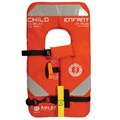
Safety of Life at Sea (SOLAS) Lifejackets
These ones perform the best in water, turning you on your back
within seconds. They only come in the keyhole model, but are
available in two sizes: for those over 70lbs (32kgs) or under
70lbs. They're approved for use on all vessels, but are designed to
extend survival in rough, open water where rescue could be slower.
These can be foam or inflatable (automatically, manually, or orally
inflated).
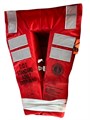
Standard Type Lifejackets
These lifejackets are a bit slower to turn you on your back.
They're approved for all vessels except
SOLAS vessels and for use on calm, inland water where there is
a chance of fast rescue. They also only come in the keyhole model,
but are available in two sizes: for individuals over and under
88lbs (40kgs).
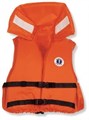
Small Vessel Lifejackets
As the name suggests, these lifejackets are approved for small
vessels only and designed for use in calm water with a higher
chance of fast rescue. They are the slowest at turning you onto
your back compared to the other lifejackets. They come in three
sizes: for individuals over 90lbs (41kgs), between 40-90lbs, and
under 40lbs (18kgs). These lifejackets also come in the keyhole
model as well as the vest model.
Inflatable pfds
- Inflatable PFDs come in two approved styles: vest and
pouch. Vest styles can inflate automatically, manually, by
pulling a toggle, or orally. Pouch styles can be orally or manually
inflated by pulling a toggle. Though inflation time for PFDs is
short, it could still be too long for a weak swimmer, and using the
inflation tube orally that all Canadian-approved PFDs have could be
difficult during an emergency.
- Inflatable PFDs are prohibited for:
- children under the age of 16
- anyone who weighs under 80lbs (36.3kgs)
- use on personal watercrafts (e.g., Sea-Doo, Jet Ski)
Tips for Water Smart Parents
- A lifejacket is not a substitute for adult supervision.
- A lifejacket should fit snugly and not ride up over your
child's chin or ears.
- If there are more than 3 inches between your child's shoulders
and the lifejacket, it is too big.
- A large collar is good for supporting your child's head.
- The safety strap that goes between the legs prevents the
lifejacket from slipping over your child's head.
- Bright colours like red, orange, yellow and pink are
reccomended for the best visibility in water.
- The safest lifejackets and PFDs are approved by Transport
Canada, the Canadian Coast Guard, or Fisheries and Oceans Canada,
which is indicated on the inside label.
- There are no approved lifejackets or PFDs for children under
20lbs. It's recommended that you wait until your child is over
20lbs before taking them boating. Flotation devices do exist for
children under 20lbs, if your child must be on a boat before they
are 20lbs, look for these qualities in a flotation vest:
- Large collar/head support
- Handle/grab strap at the top of collar for easier removal from
the water if necessary
- Leg straps
- Secure buckles/zippers
- Snug fit
Learn to Swim
Basic swimming ability is a fundamental requirement in any
meaningful attempt to eliminate drowning in Canada. The Lifesaving
Society offers training programs from learn-to-swim through advanced lifesaving, lifeguarding and
leadership.
Swim to
Survive is a Lifesaving Society survival training program. Swim
to Survive is not a substitute for swimming lessons; instead, it defines the
minimum skills needed to survive an unexpected fall into deep
water. People of all ages should be able to perform the Society's
Swim to Survive standard.